Introduction
Hippocrates, Gallen, and others all used the term "pterygium," which comes from the Greek word "pterygion," which means "wing." It is a fibrovascular growth of the bulbar conjunctiva that resembles a wing and encroaches on the cornea. Bowman's membrane is destroyed and collagen fibers undergo elastotic degradation. It is substantially more common nasally than temporally and occurs in the palpebral fissure area. The head of pterygium on the cornea may be identified by elevated white opacities (called "islets of Vogt") and an iron deposition line (called "Stocker"). In tropical regions close to the equator, it is most common and severe, and in cooler climates, it is less common and milder. Its cause has been attributed to both blue and ultraviolet light [1,2]. Pterygium development is enhanced by outdoor activities in environments with strong solar reflectance from water or sand. Pterygium growth may result from UV light induced damage to limbal stem cells and matrix metalloproteinase activation [3,4]. UV exposure, dryness, wind and dust exposure, inflammation, and other irritants can all be predisposing factors [5]. In limbal basal stem cells, UV-B is mutagenic for the p53 tumor suppressor gene. Angiogenesis, cellular migration, and collagenase up-regulation are caused by the over expression of cytokines such vascular endothelial growth factor (VEGF) and transforming growth factor-beta (TGF). Collagen elastoid degradation and the development of sub epithelial fibro vascular tissue are the pathologic alterations that follow. The epithelium can occasionally exhibit dysplasia [6,7]. Reduced visual acuity is caused by changes in the tear film or by the mechanical effects of pterygium. When pterygia encroach on the visual axis, cause noticeable regular or irregular astigmatism, or become annoying from a cosmetic standpoint, they should be treated. Eye lid distortion and restrictive strabismus are additional symptoms of aggressive or recurrent pterygium [8]. Numerous surgical methods have been created. The majority of treatments for minor primary pterygiums are straight forward removal of the pterygium on the sclera and cornea [9]. Preventing recurrence has been the aim of treatment for bigger and recurring pterygium. Recurrence rates using more traditional methods, such as the "bare sclera technique," have been quite high (40–50%). At the moment, Mitomycin-C application and conjunctival auto-grafting are the most popular methods. The recurrence rate has been lowered to about 5% with the use of the current method. It has also been demonstrated that human amniotic membrane transplants work well. For conjunctival auto-grafting, fibrin-based glues and autologous blood fibrin have been employed to cut down on suture discomfort and operating time while also lowering the number of suturing needed [10].
The sutured and suture-less method(cut and paste technique) of conjunctival auto-graft for pterygium treatment have been compared in this study. In the suture-less procedure, we pasted the conjunctival auto- graft using the blood that oozed from the arteries following pterygium removal, which is simple “cut and paste technique without using fibrin glue.
Material And Methods
It was a comparative clinical trial that was randomized. The investigation was carried out in a tertiary care hospital. The trial lasted for eighteen months. The study only included patients who provided their consent and had primary pterygium in one or both eyes that measured more than 2 mm in horizontal length from the limbus encroaching over the cornea. The study excluded patients having a history of ocular surgery, bleeding disorders, anticoagulant therapy, keratoconus, corneal dystrophy, corneal scarring, recurrent pterygium, or pseudo-pterygium. A specially created proforma was used to gather the specifics of the patient's history and clinical examination results following the acquisition of written and informed consent. A comprehensive ocular examination was performed following a thorough history. Every patient had preoperative evaluations for visual acuity, posterior segment examination, keratromery, and anterior segment examination with a focus on pterygium type and morphology based on vascularization and progression. Using a well-lit Snellen's visual acuity chart, the patient's visual acuity and best corrected visual acuity (BCVA) were measured for each eye independently while they were seated six meters away. A handheld ultrasound pachymeter (Model 300P Sonomed, USA) was used to assess the central corneal thickness (CCT). To determine whether dry eye and pterygium are related, a clinical evaluation of the tear film in both eyes was conducted using the Schirmer test-I. By focusing the slit on the pterygium and using the slit ruler built into the slit lamp, the preoperative horizontal length of the pterygium was measured from the limbus to the advancing edge of the pterygium. Under an operating microscope, a single surgeon carried out the procedure. All patients received peribulbar anesthesia in the hopes that akinesia lasting a few hours after surgery would help to keep the graft from moving. Pterygium excision was initiated after a demarcation mark was formed on the cornea 1 mm ahead of the pterygium head using a 15 No size surgical blade. The pterygium's head was removed from the corneal surface using traction avulsion and delicate dissection. The pterygium's neck and body were also removed, and its tissue was removed after it had been delineated and separated from the underlying sclera and the conjunctiva. Hemostasis was permitted to happen naturally in both groups without the need for cautery. Using calipers, the area of the bare sclera was measured, and a conjunctival autograft from the same eye's superotemporal quadrant that was one mm larger than the bare sclera in both dimensions was taken. In order to ensure that the limbal side of the free graft was aligned with the limbus at recipient site, the auto-graft was meticulously removed, dissected thinly, and carefully transposed to the recipient site while avoiding Tenon's capsule. Subjects were divided into two groups (Group A&B). In group-A (n=21), the patient's own blood dripping from the limbal veins adhered the auto graft to the underlying episcleral bed. In group B (n=21), minimum sutures with 8-0 silk were used to suture the auto graft with the surrounding conjunctiva. The time from the placement of the lid speculum and its removal at the conclusion of the procedure was taken into account when calculating the length of the procedure. Gentamycin and dexamethasone were injected subconjunctivally at the conclusion of the procedure. In both groups, pad and patching was done for a full day. Topical moxifloxacin 0.5% (one drop six times per day) and topical flouromethalone (one drop four times per day for one week, thereafter to be tapered in the second week) were prescribed to all patients from the first postoperative day. Seven days following the procedure, the conjunctival sutures were removed in group B. To the foregoing regimen, patients with concomitant dry eye were given tear substitutes.
Patients were assessed for keratometry, best corrected visual acuity, and visual acuity during follow-up. Following surgery, these measurements were taken 48 hours, one week, two weeks, six weeks, and three months later. The length of the procedure, the keratometry reading (at each follow-up), the autograft's dehiscence rate, the pterygium's recurrence rate three months after the procedure, and the observation of post-operative pain such as watering, a feeling of a foreign body, and itching in both groups were used to gauge the effectiveness of the procedure. At each follow-up, the presence or absence of the symptoms of itching, watering, and a foreign body sensation was recorded.
The "t"-test was used to examine the keratometric readings and operation time, which were summarized by mean and standard deviation. Rates were used to describe post-operative comfort, and the Chi-square test was used for analysis.
Results
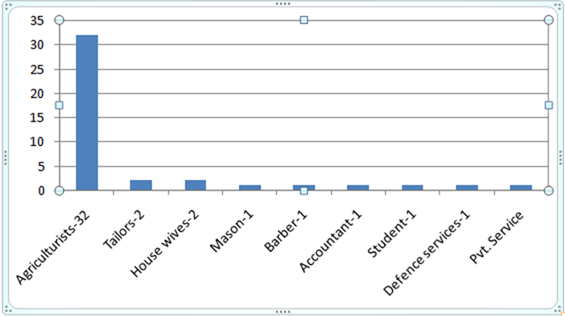
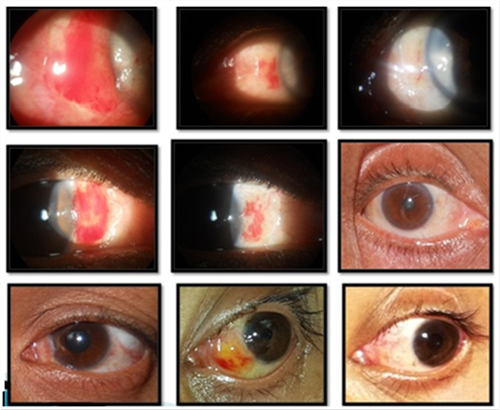
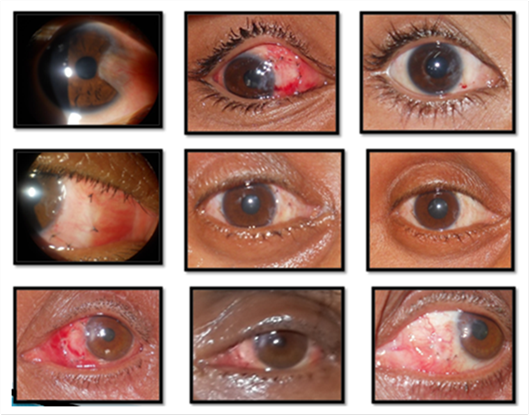
A total of 42 subjects with primary pterygium were studied. Seventeen (40.5%) were male and 25 (59.5%) were female. The mean age of subjects was 54.85±17.11 and 47.81±16.81 years in Group-A and B respectively. Age range was 19 to 82 years. All subjects were from rural area (n=42). Maximum number of subjects were agriculturists (32 subjects: 76.2%). (Figure1). Most of these subjects (n=34: 80.9%) gave history of 6 to 8 hours of average exposure to sunrays per day. Maximum number of the patients (n=35: 83.3%) had not used any kind of eye drops before presentation. Twenty one subjects (50%) presented with bilateral pterygium and 21 subjects (50%) presented with unilateral pterygium (OD: n=11 and OS: n=10). Twenty one cases were operated with suture-less technique (GroupA) and 21 cases were operated with sutured graft technique (GroupB). Mean horizontal length of the pterygium in the operated eyes was 3.13±0.76 and 3.21±0.66 mm in group-A and B respectively (Table1). Mean pre-operative corneal astigmatism of the operated eyes was 4.26±3.10D (WTR) and 4.98±3.41D (WTR) in group-A and B respectively (Table1). Mean post-operative corneal astigmatism of the operated eyes was 1.03±0.66D (WTR) and 1.26±0.84D (WTR) in Group-A and B respectively (Table1). Relation between the size of pterygium and corneal astigmatism was studied. Significant association was observed between corneal astigmatism and the size of pterygium (correlation coefficient: 0.79), with p value=0.0001 (Table1, Figure2). Schirmer’s test was normal in 83.3% cases (n=35). Three subjects (7.14%) presented with mild dry eye. Two subjects presented with moderate dry eye and 2 subjects with severe dry eye. Twenty right eyes and 22 left eyes were operated. Mean surgical time was 15.04±1.47 and 27.83±1.82 minutes in Group-A and B respectively. This difference was statistically significant with p-value <0.001(Table-1). On 1st week follow-up, post operative discomfort (watering and foreign body sensation) was present in all subjects (21subjects:100%) in Group-B, where as in Group-A, watering was present in 19% n=(4) and foreign body sensation was present in 9.5 % (n=2) only. On 3 months follow-up, recurrence was seen in one case (4.8%) in Group-B and no recurrence occurred in Group=A. Partial Graft dehiscence occurred in one case in Group-A (4.8%) and extrusion of Tenon’s at donor site occurred in one case in Group-B (4.8%). Photographs were taken at each follow-up visit to observe for the process of healing at the recipient site and donor site. On first post-op day there was no edema of the graft but on second and third post operative day the graft was seen as edematous. And within next few days patchy or diffuse hemorrhage was seen within the graft demonstrating re-perfusion injury of the graft. This edema and hemorrhage resolved within next 3-4 weeks post-operatively. Difference in the pattern of healing was observed between both these techniques as edema and hemorrhage within the graft was more marked in Group-A (Figure3), in comparison to Group-B (Figure4) which may be attributed to the fact that in Group-B, the graft was stretched and stable due to sutures which prevented marked edema and re-perfusion injury. Post operative discomfort was more marked in Group-B which persisted till the sutures were removed after one week follow-up.
| Surgical technique1.0-Cut and paste suture less technique2.0 Sutured –technique | N | Mean | Standard Deviation | P value | |
| AGE | 1.0 | 21 | 54.85 | 17.11 | 0.19 |
| 2.0 | 21 | 47.81 | 16.81 | ||
| Exposure to sun rays in hours per day | 1.0 | 21 | 6.67 | 2.22 | 0.47 |
| 2.0 | 21 | 6.14 | 2.45 | ||
| 2.0 | 21 | 1.09 | .30 | ||
| HORIZONTAL LENGTH in mm | 1.0 | 21 | 3.13 | .76 | 0.73 |
| 2.0 | 21 | 3.21 | .66 | ||
| WIDTH in mm | 1.0 | 21 | 5.57 | .59 | 1.00 |
| 2.0 | 21 | 5.57 | .85 | ||
| Corneal astigmatism Preoperative of operated eye | 1.0 | 21 | 4.26 | 3.10 | 0.48 |
| 2.0 | 21 | 4.98 | 3.41 | ||
| Post operative corneal astigmatism | 1.0 | 21 | 1.03 | .66 | 0.34 |
| 2.0 | 21 | 1.26 | .84 | ||
| CCT in µm (OD) | 1.0 | 21 | 517.23 | 25.11 | 0.56 |
| 2.0 | 21 | 521.90 | 26.14 | ||
| CCT in µm (OS) | 1.0 | 21 | 518.76 | 25.60 | 0.59 |
| 2.0 | 21 | 522.95 | 24.84 | ||
| IOP (OD) | 1.0 | 21 | 14.95 | 2.20 | 0.95 |
| 2.0 | 21 | 14.90 | 3.08 | ||
| IOP (OS) | 1.0 | 21 | 15.90 | 2.38 | 0.32 |
| 2.0 | 21 | 15.04 | 3.07 | ||
| SURGERY TIME IN Minutes | 1.0 | 21 | 15.40 | 1.47 | <0.001 |
| 2.0 | 21 | 27.83 | 1.82 |

Correlation coefficient: 0.79, p: < .0001
Discussion
Forty two subjects with primary pterygium were studied, out of which 59.5% (n=25) were female and 40.5% (n=17) were male. All subjects (n=42) were from rural area and 76.2% (n=32) were agriculturists and other were barber, tailors etc by profession. The average exposure to direct sunrays per day being 6-8 hours, which strongly correlates with exposure to UV rays, wind dust and other irritants (Figure1). Chronic inflammation and minor trauma due to dust in professions like agriculture, hair-cutting and tailoring etc may lead to fibrovascular growth on exposed ocular surface [11,12,13].
Based on the size, pterygium was classified into three types: Type-1: Pterygium encroaching 0-2 mm horizontally on the cornea. Type-2: Pterygium encroaching, 2.1mm-4mm horizontally on the cornea. Type-3: Pterygium encroaching >4mm horizontally on the cornea. Type-2 and Type-3 were included in the study. Of the 42 subjects studied, 35 were type-2 (2.1 to 4 mm size in horizontal length) and seven were Type-3 (>4mm size in horizontal length) [14]. Mean horizontal length among the operated eyes was 3.13±0.76mm and 3.21±0.66mm, for sutureless and sutured graft technique respectively. Schirmer’s test- I was done in all subjects preoperatively, it was normal in 35 subjects (83.33%). Three subjects presented with mild dry eye and two subjects each presented with moderate and severe dry eye.
Pterygium induces significant astigmatism which may be either ‘with the rule’ (WTR) or ‘against the rule’ (ATR). Tractional force of contractile elements within the pterygium leads to mechanical distortion and flattening of cornea in its horizontal meridian along with pooling of tears at the advancing edge of the pterygium, both of these lead to hyper-metropic WTR astigmatism. Popat KB et al.,[14] in their study observed that the mean corneal astigmatism preoperative was 6.20±3.58 D which subsequently decreased to 1.20±1.27 on 45th post operative day. In our study the mean pre-operative corneal astigmatism of the operated eyes was 4.26±3.10D (WTR) and 4.98±3.41D (WTR), respectively for suture less technique and sutured graft technique. Mean post-operative corneal astigmatism of the operated eyes was 1.03±0.66 D(WTR) and 1.26±0.84D (WTR), respectively for suture less technique and sutured graft technique. It shows that corneal topographic changes caused by pterygium are almost reversible after surgical treatment and post operatively the cornea becomes steeper. Relationship between the size of pterygium and corneal astigmatism was studied and it was found that corneal astigmatism increases with increase in size of pterygium (correlation coefficient: 0.79, p value: <.0001). (Table:1 & Figure:2). Different sizes of pterygia may lead to various types of topographic and refractive changes in the cornea [15-17].
In 1985, Kenyon and associates initially reported using conjunctival autograft transplantation as a therapy for pterygium [18]. Pterygium recurrence can be prevented by a number of techniques, including conjunctival autograft, conjunctival flap and conjunctival rotation autograft surgery, amniotic membrane transplant, cultured conjunctival transplant, lamellar keratoplasty, fibrin glue application, and radiation therapy in addition to surgery [19-21]. Patients using any of these techniques run the risk of developing suture or fibrin glue problems [22,23]. It takes longer to operate when autografts are attached with sutures. In addition to increasing post-operative discomfort, suture application can result in local problems such as foreign body granuloma, infection, and scarring. Since fibrin glue is made from human plasma, there is a chance that it could spread disease [24,25].
We have used the glue-less technique of simlple “cut and paste” of the auto-graft, in Group A(n=21 cases) and in Group B(n=21), 8-0 silk suture was used to attach the conjunctival auto-graft. We have compared both these techniques. On 1st week follow-up, post operative discomfort (watering and foreign body sensation) was present in all subjects (21subjects:100%) in Group-B, where as in Group-A, watering was present in 19% (4 subjects) and F.B sensation was present in 9.5 % (2 subjects) only. We observed that the mean surgical time was 15.04±1.47minutes in Group A and 27.83±1.82 minutes in Group B. This difference in the surgical timewas statistically significant (p-value <0.001). Partial Graft dehiscence occurred in one case (4.76%)in Group and extrusion of Tenon’s at donor site occurred in one case (4.76%) in Group B. Difference in the pattern of healing was observed in both these techniques. Edema and hemorrhage within the graft was more marked in Group A in comparison to Group B, which may be attributed to the fact that in sutured graft technique, the graft was stretched and stable due to sutures which prevented marked edema and perfusion injury. Ghoz N et al.,[26]in their study titled“healing of autologous conjunctival grafts in pterygium surgery” in 32 eyes of 28 patients observed thatin all eyes, healing of auto grafts started with graft swelling due to edema and transudation followed by re‐perfusion injury, which manifested as swelling, variable vessels caliber, patchy or diffuse hemorrhage occurring within first week and resolving by fourth postoperative week. Graft vessels anastomose with vessels in surrounding conjunctiva and underlying epi-sclera to re‐establish blood circulation. Conjunctival auto-grafts are not at risk of falling off, losing epithelial cover or undergoing necrosis.
We observed that recurrence rate on 3month follow-up was 4.76% in Group B and no recurrence occurred in Group A. Huerva V et al.,[25] in their retrospective study on 112 patients observed that on one year follow-up the recurrence rate was 11.76% who had undergone conjunctival auto graft surgery. It has been reported that the recurrence rate with various conjunctival auto-graft techniques vary from 5 to 10%.
Conclusion
Surgery time and post-operative discomfort was significantly less in cut and paste (suture less) technique in comparison to sutured graft technique, with successful adherence of the auto-graft. A difference in the healing pattern of the graft was observed between both these techniques. Although edema and hemorrhage within the grafts was observed in both the groups in early post operative days, but it was more marked in subjects with cut and paste (suture less) technique. Re‐perfusion injury in early postoperative days produces dramatic changes in the auto-graft for which patients should be counseled before surgery. Significant reduction in the corneal astigmatism was observed after the surgery in both techniques.
Declarations
Acknowledgements
None
Contributors
All authors contributed equally
Conflict of interest
Nil
Funding agency
Nil