Introduction
Global population aging is one of the most significant demographic shifts of the 21st century. By 2050, the global population aged 60 years and above is projected to double, reaching 2.1 billion, with nearly 80% residing in low- and middle-income countries [1]. India, home to over 149 million elderly individuals in 2022, is witnessing an accelerated aging trajectory, with the proportion of elderly expected to rise to 20.8% by 2050 [2]. This demographic transition brings forth complex public health challenges, including the rising prevalence of geriatric syndromes such as frailty, cognitive decline, and diminished psychological well-being.
Frailty is a state of increased vulnerability due to age-associated decline in physiological reserves and is a strong predictor of adverse outcomes such as falls, hospitalization, disability, and mortality [3,4]. In India, a recent meta-analysis reported a pooled frailty prevalence of 42.3%, with significant regional variations [5]. Mild Cognitive Impairment (MCI), often a prodromal stage of dementia, affects an estimated 17.6% of Indian older adults, representing approximately 24 million individuals [6]. Both conditions are found to coexist frequently, leading to a construct of "cognitive frailty," which exacerbates functional decline and care dependency [7].
Beyond physical and cognitive health, subjective well-being, measured as life satisfaction, is a critical component of healthy aging. Life satisfaction reflects an individual’s cognitive judgment of their life as a whole and is influenced by health status, social support, socioeconomic conditions, and independence[8]. While some studies suggest that older adults in India report relatively high life satisfaction [9], the impact of frailty and cognitive impairment on this dimension remains poorly understood, particularly in urban communities undergoing rapid social change.
Most existing studies in India have examined frailty, MCI, or life satisfaction in isolation, often in clinical or institutional settings. There is a paucity of community-based research exploring the interrelationships among these domains. The findings intend to inform integrated geriatric care strategies tailored to the urban Indian context. The present study aims to determine the prevalence of frailty, MCI, and life satisfaction and to explore their interrelationships among the elderly in Delhi.
Materials and Methods
Study Design and Setting
A community-based cross-sectional study was conducted in Aliganj, an urbanized village in South Delhi. The area has an estimated population of 20,000–25,000.
Study Population and eligibility criteria
The study included individuals aged 60 years and above who were residents of Delhi for at least six months and provided written informed consent. Exclusion criteria included severe cognitive impairment (pre-diagnosed dementia), severe psychiatric illness, acute medical instability, or inability to comprehend the questionnaire.
Sample size
Sample size was calculated using the formula for prevalence estimation: n=Z2×p(1−p)/d2, where Z=1.96, Z=1.96 (95% confidence level), p=0.323 [10], and d=0.07 (absolute error). The minimum sample size was 170. Accounting for a 10% non-response rate, the minimum sample size was 190. Ultimately, 221 participants were enrolled.
Data Collection Tools
A pre-tested, semi-structured interview schedule was administered face-to-face using encrypted Google Forms. The tool comprised of Sociodemographic details (age, gender, marital status, religion, caste, education, occupation, socioeconomic status using the Modified Kuppuswamy Scale 2025 [11], Lifestyle characteristics (tobacco use, alcohol use, physical activity, history of chronic diseases, history of falls in the past year), validated Edmonton Frail Scale (EFS) - A 9-domain tool (cognition, general health, functional independence, social support, medication use, nutrition, mood, continence, functional performance) scored 0-17. Scores were categorized as: Not frail (0-3), Vulnerable (4-5), Mild frailty (6-7), Moderate frailty (8-9), and Severe frailty (≥10). The Hindi version was used, for which permission was taken from the competent authority [12], validated Montreal Cognitive Assessment (MoCA) - Assesses visuospatial/executive function, naming, attention, language, abstraction, delayed recall, and orientation. Scores range from 0-30, with <26 indicating MCI. One point was added for individuals with ≤12 years of education. The freely available validated Hindi MoCA (H-MoCA) version was used [13], validated Satisfaction with Life Scale (SWLS), which is a freely available 5-item scale rated on a 7-point Likert scale (1=Strongly Disagree to 7=Strongly Agree). Total scores (5–35) were categorized as: Extremely Dissatisfied (5-9), Dissatisfied (10-14), Slightly Dissatisfied (15-19), Neutral (20-24), Slightly Satisfied (25-29), Satisfied (30-31), and Extremely Satisfied (32-35) [14].
Study Procedure
A convenience sampling approach was employed to recruit participants. The investigators systematically visited households in the area. Households were visited sequentially, and eligibility was assessed based on the inclusion/exclusion criteria. If a household contained more than one eligible elderly individual (aged ≥60 years), one participant was selected using a simple random method (lottery system) to prevent clustering effects and ensure independence of observations. In cases where no eligible participant was available or the household was locked, the next consecutive household was approached. This process continued until the target sample size was achieved. Interviews lasted approximately 30-40 minutes. Participants identified with health issues were referred to appropriate healthcare facilities.
Statistical Analysis
Data were exported from Google Forms to Microsoft Excel, anddata were cleaned, coded, and analyzed using SPSS version 26.0. Categorical variables were summarized as frequencies and percentages. Detailed category-specific proportions are presented in Supplementary Tables S1 and S2. Continuous variables were described using mean and standard deviation. Associations between categorical variables were examined using the Chi-square test or Fisher’s exact test (where expected cell counts were <5). Spearman’s rank correlation coefficient (ρ) was used to assess relationships between scale scores (EFS, MoCA, SWLS). All tests were two-tailed, and a p-value <0.05 was considered statistically significant.
Ethical Considerations
Ethical approval was obtained from the Institutional Ethics Committee (IEC) (ref no- IEC/VMMC/SJH/Cert./oct-2025/02). Written informed consent was taken from all participants and necessary permissions were obtained to use the scale. Confidentiality was maintained, and data were stored securely with access limited only to the research team.
Results
The study included 221 participants, with a mean age of 68.4 (±6.7) years. As shown in Table 1, the majority of participants were aged 60–70 years (75.5%) and male (61.5%). Most were married (85.9%), Hindu (97.3%), and unemployed (74.7%). A significant proportion were illiterate (39.8%), and the largest socioeconomic group was lower middle class (41.3%). Chronic diseases were reported by 68.3% of participants, and a history of falls in the past year was reported by 66.5%. Tobacco and alcohol use were reported by 32.8% and 17.6%, respectively.
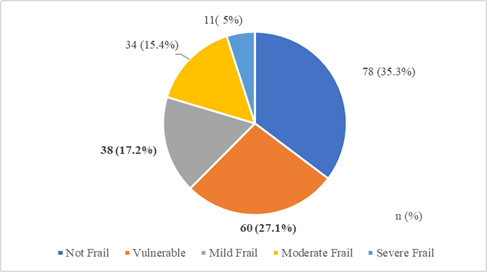
The overall prevalence of frailty was 37.6% (95% CI: 31.3–44.4). As depicted in Figure 1, the distribution of frailty categories was: Not frail (35.3%), Vulnerable (27.1%), Mild frailty (17.2%), Moderate frailty (15.4%), and Severe frailty (5.0%). Frailty was significantly associated with several sociodemographic and lifestyle factors (Table 2). Participants aged ≥71 years had significantly higher odds of being frail compared to those ≤70 years (χ²=13.84, p<0.001). Illiteracy was strongly associated with frailty (χ²=8.09, p=0.004), with 51.8% of frail participants being illiterate compared to 32.6% of non-frail participants. Unemployment (χ²=5.06, p=0.024), lower socioeconomic status (χ²=10.26, p=0.006), presence of chronic diseases (χ²=7.75, p=0.005), and history of falls (χ²=12.32, p<0.001) were also significantly associated with frailty. Gender, marital status, religion, caste, number of children, and substance use did not show significant associations. Detailed domain-wise distribution of EFS scale among study participants is given in Supplementary Table 1.
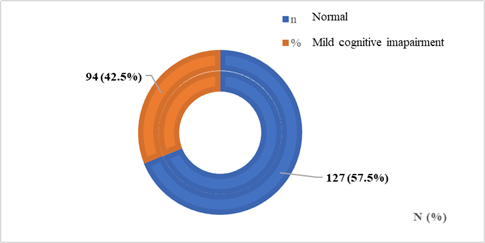
Mild Cognitive Impairment (MoCA score <26) was present in 42.5% (95% CI: 35.9–49.3) of participants. Figure 2 illustrates the distribution, with 57.5% having normal cognition and 42.5% having MCI. As shown in Table 3, MCI was significantly associated with older age (χ²=9.82, p=0.002), illiteracy (χ²=11.34, p<0.001), unemployment (χ²=3.49, p=0.049), lower socioeconomic status (χ²=9.12, p=0.010), and history of falls (χ²=3.70, p=0.045). Notably, 52.1% of participants with MCI were illiterate compared to 30.7% of those with normal cognition. Similar to frailty, gender, marital status, religion, caste, and substance use did not show significant associations with MCI. Detailed domain-wise distribution of MoCA scale among study participants is given in Supplementary Table 2.
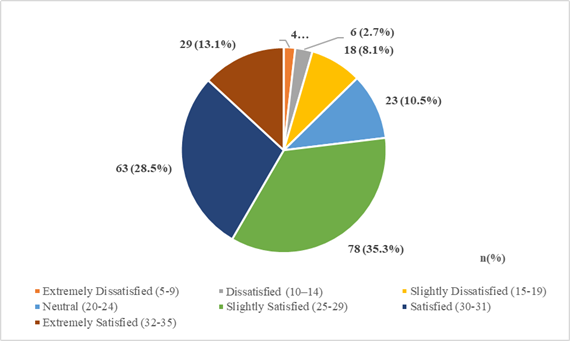
Life satisfaction scores, assessed using the Satisfaction with Life Scale, were generally positive (Table 4). Overall, 76.9% of participants reported being at least slightly satisfied with their lives (35.3% slightly satisfied, 28.5% satisfied, 13.1% extremely satisfied), while only 12.6% reported varying degrees of dissatisfaction (Figure 3). The most endorsed statement was "So far, I have gotten the important things I want in life" (62.9% agreement), while the least endorsed was "If I could live my life over, I would change almost nothing" (56.6% agreement). All five SWLS items showed significant differences between satisfied and dissatisfied participants (p<0.001 for all comparisons).
Spearman's correlation analysis revealed significant relationships between the three main study variables (Table 5). There was a strong positive correlation between frailty and mild cognitive impairment (ρ=0.560, p<0.001), indicating that higher frailty scores were associated with poorer cognitive performance. Both frailty (ρ=-0.480, p<0.001) and mild cognitive impairment (ρ=-0.520, p<0.001) showed moderate negative correlations with life satisfaction, suggesting that as physical and cognitive health declines, life satisfaction decreases. The coefficient of determination (r²) values indicated that frailty explained 23% of the variance in life satisfaction scores, while MCI explained 27% of the variance.
| Variable | n(%) |
| Age categories (in completed years) | |
| 60-65 | 101 (45.2) |
| 66-70 | 67 (30.3) |
| 71-75 | 28 (12.8) |
| 76-80 | 17 (7.7) |
| >80 | 9 (4) |
| Gender | |
| Male | 136 (61.5) |
| Female | 85 (38.5) |
| Marital status | |
| Married | 192 (85.9) |
| Divorced | 4 (1.8) |
| Widow | 25 (11.3) |
| Religion | |
| Hinduism | 215 (97.3) |
| Others (Islam, Christianity, Sikhism) | 6 (2.7) |
| Caste | |
| General | 80 (36.4) |
| OBC | 62 (27.7) |
| SC | 53 (24.1) |
| ST | 26 (11.8) |
| Occupation | |
| Gainfully employed | 56 (25.3) |
| Unemployed | 165 (74.7) |
| Education status | |
| Illiterate | 88 (39.8) |
| Primary school | 20 (9) |
| Middle school | 40 (18.1) |
| High school | 48 (21.8) |
| Intermediate/diploma | 13 (5.9) |
| Graduate | 11 (5) |
| Socioeconomic Status (Modified Kuppuswamy Scale, 2025) | |
| Upper | 11 (5) |
| Upper middle | 60 (27.2) |
| Lower middle | 91 (41.3) |
| Upper lower | 58 (25.9) |
| Lower | 1 (0.6) |
| No. of children | |
| <2 | 5 (2.3) |
| ≥2 | 216 (97.7) |
| Any form of tobacco use | |
| Yes | 72 (32.8) |
| No | 149 (67.2) |
| Alcohol use | |
| Yes | 39 (17.6) |
| No | 104 (47) |
| Unwilling to tell | 78 (35.2) |
| History of chronic disease | |
| Yes | 151 (68.3) |
| No | 70 (31.7) |
| History of falls | |
| Yes | 147 (66.5) |
| No | 74 (33.5) |
| Variable | Categories | Not Frail (n=138) n (%) | Frail (n=83) n (%) | X2 value | p-value |
| Age categories (in completed years) | ≤70 | 116 (84.1) | 52 (62.7%) | 13.84 | <0.001 |
| ≥71 | 22 (15.9) | 31 (37.3%) | |||
| Gender | Male | 91 (65.9) | 45 (54.2) | 2.99 | 0.084 |
| Female | 47 (34.1) | 38 (45.8) | |||
| Marital status | Married | 122 (88.4) | 70 (84.3) | - | 0.422 |
| Not Married (Divorced/Widow) | 16 (11.6) | 13 (15.7) | |||
| Religion | Hinduism | 135 (97.8) | 80 (96.4) | - | 0.512 |
| Other | 3 (2.2) | 3 (3.6) | |||
| Caste | General | 56 (40.6) | 24 (28.9) | 3.16 | 0.075 |
| OBC/SC/ST | 82 (59.4) | 59 (71.1) | |||
| Occupation | Gainfully employed | 42 (30.4) | 14 (16.9) | 5.06 | 0.024 |
| Unemployed | 96 (69.6) | 69 (83.1) | |||
| Education status | Illiterate | 45 (32.6) | 43 (51.8) | 8.09 | 0.004 |
| Literate (Primary school or above) | 93 (67.4) | 40 (48.2) | |||
| Socioeconomic Status | Upper/Upper middle | 52 (37.7) | 19 (22.9) | 10.26 | 0.006 |
| Lower middle | 57 (41.3) | 34 (41) | |||
| Upper lower/Lower | 29 (21) | 30 (36.1) | |||
| No. of children | <2 | 4 (2.9) | 1 (1.2) | - | 0.395 |
| ≥2 | 134 (97.1) | 82 (98.8) | |||
| Tobacco use | Yes | 41 (29.7) | 31 (37.3) | 1.33 | 0.249 |
| No | 97 (70.3) | 52 (62.7) | |||
| Alcohol use | Yes | 22 (15.9) | 17 (20.5) | 2.01 | 0.366 |
| No | 69 (50) | 35 (42.2) | |||
| Unwilling to tell | 47 (34.1) | 31 (37.3) | |||
| Chronic disease | Yes | 85 (61.6) | 66 (79.5) | 7.75 | 0.005 |
| No | 53 (38.4) | 17 (20.5) | |||
| History of falls | Yes | 80 (58) | 67 (80.7) | 12.32 | <0.001 |
| No | 58 (42) | 16 (19.3) |
‘-’ = Fischer exact test
| Variable | Categories | Normal(n=127) n(%) | MCI (n=94) n(%) | X2value | Pvalue |
| Age categories (in completed years) | ≤70 | 106 (83.5) | 62 (66) | 9.82 | 0.002 |
| ≥71 | 21 (16.5) | 32 (34) | |||
| Gender | Male | 82 (64.6) | 54 (57.4) | 1.18 | 0.277 |
| Female | 45 (35.4) | 40 (42.6) | |||
| Marital status | Married | 112 (88.2) | 80 (85.1) | - | 0.503 |
| Not Married (Divorced/Widow) | 15 (11.8) | 14 (14.9) | |||
| Religion | Hinduism | 124 (97.6) | 91 (96.8) | - | 0.698 |
| Other | 3 (2.4) | 3 (3.2) | |||
| Caste | General | 50 (39.4) | 30 (31.9) | 1.42 | 0.234 |
| OBC/SC/ST | 77 (60.6) | 64 (68.1) | |||
| Occupation | Gainfully employed | 38 (29.9) | 18 (19.1) | 3.49 | 0.049 |
| Unemployed | 89 (70.1) | 76 (80.9) | |||
| Education status | Illiterate | 39 (30.7) | 49 (52.1) | 11.34 | <0.001 |
| Literate (Primary school or above) | 88 (69.3) | 45 (47.9) | |||
| Socioeconomic Status | Upper/Upper middle | 45 (35.4) | 26 (27.7) | 9.12 | 0.010 |
| Lower middle | 54 (42.5) | 37 (39.4) | |||
| Upper lower/Lower | 28 (22.0) | 31 (33) | |||
| No. of children | <2 | 4 (3.1) | 1 (1.1) | - | 0.395 |
| ≥2 | 123 (96.9) | 93 (98.9) | |||
| Tobacco use | Yes | 37 (29.1) | 35 (37.2) | 1.60 | 0.206 |
| No | 90 (70.9) | 59 (62.8) | |||
| Alcohol use | Yes | 20 (15.7) | 19 (20.2) | 2.98 | 0.226 |
| No | 62 (48.8) | 42 (44.7) | |||
| Unwilling to tell | 45 (35.4) | 33 (35.1) | |||
| Chronic disease | Yes | 82 (64.6) | 69 (73.4) | 2.03 | 0.154 |
| No | 45 (35.4) | 25 (26.6) | |||
| History of falls | Yes | 78 (61.4) | 69 (73.4) | 3.70 | 0.045 |
| No | 49 (38.6) | 25 (26.6) |
‘-’ = Fischer exact test
| SWLS Question | Strongly Disagree n(%) | Mostly Disagree n(%) | Somewhat Disagree n(%) | Neutral n(%) | Somewhat Agree n(%) | Mostly Agree n(%) | Strongly Agree n(%) |
| My life is close to my ideal | 18 (8.1) | 12 (5.4) | 27 (12.2) | 33 (14.9) | 62 (28.1) | 41 (18.6) | 28 (12.7) |
| The conditions of my life are excellent | 15 (6.8) | 9 (4.1) | 26 (11.8) | 38 (17.2) | 70 (31.7) | 35 (15.8) | 28 (12.7) |
| I am satisfied with my life | 18 (8.1) | 7 (3.2) | 22 (10) | 33 (14.9) | 72 (32.6) | 38 (17.2) | 31 (14) |
| So far, I have gotten the important things I want in life | 13 (5.9) | 7 (3.2) | 27 (12.2) | 35 (15.8) | 74 (33.5) | 35 (15.8) | 30 (13.6) |
| If I could live my life over, I would change almost nothing | 25 (11.3) | 9 (4.1) | 26 (11.8) | 36 (16.3) | 68 (30.8) | 32 (14.5) | 25 (11.3) |
| Variables | Spearman’s Rho | r2 | P value |
| Frailty – Mild cognitive impairment | 0.560 | 0.31 | 0.000 |
| Frailty – Life satisfaction score | –0.480 | 0.23 | 0.000 |
| Mild cognitive impairment – Life satisfaction score | –0.520 | 0.27 | 0.000 |
*r2 =coefficient of determination
Discussion
This community-based cross-sectional study reveals a substantial burden of frailty (37.6%) and mild cognitive impairment (42.5%) among urban elderly in Delhi, with both conditions significantly interlinked and negatively associated with life satisfaction. The findings contribute to the growing evidence on geriatric syndromes in rapidly aging populations and highlight the complex interplay between physical, cognitive, and psychosocial health domains.
The prevalence of frailty in our study aligns with the pooled Indian estimate of 42.3% reported in a recent meta-analysis conducted by Debnath A et al.,[5] but is higher than figures from some community-based studies by Meratwal G et al.,[10] (32.3%) and in tertiary care settings by Vadanere NP et al.,[15]. This variation may reflect differences in urban-rural contexts, assessment tools, and socioeconomic profiles. The use of the Edmonton Frail Scale, which incorporates multidimensional domains including cognition and social support, may yield higher prevalence estimates compared to purely physical frailty assessments. Our finding that illiteracy, unemployment, lower socioeconomic status, chronic diseases, and a history of falls were significantly associated with frailty corroborates the study conducted by Das S et al.,[16] It emphasizes the role of social determinants in frailty development. The strong association with falls history (80.7% in frail vs. 58.0% in non-frail) is particularly concerning, as falls represent both a consequence and an exacerbating factor of frailty, as done by Dhanalakshmi V et al. [17]
The high prevalence of MCI (42.5%) exceeds the 17.6% reported in the nationally representative LASI-DAD study [6] and estimates from other studies ranging from 14-30% by Yang F et al. [18] and Del Brutto OH et al. [19]. This discrepancy may be attributed to several factors. First, the high illiteracy rate (39.8%) in our sample likely affected MoCA performance despite education-adjusted scoring. As Gupta M et al. [13] noted in their validation of the Hindi MoCA, educational bias remains a challenge even with scoring adjustments. Second, our urban community-based sample may differ from nationally representative samples in terms of risk factor exposure and healthcare access. Third, the relatively small sample size and convenience sampling may have introduced selection bias. Nevertheless, our finding that illiteracy was the strongest predictor of MCI (52.1% in MCI vs. 30.7% in normal cognition) aligns with global evidence on education as a protective factor against cognitive decline, as carried out by Robertson DA et al. [20].
The strong correlation between frailty and MCI (ρ=0.560) supports the concept of "cognitive frailty" and mirrors findings from international cohorts. Studies by Brahmankar M et al. [21]andMuir SW et al. [22] have similarly reported significant associations between physical frailty and cognitive impairment, suggesting shared pathophysiological pathways including chronic inflammation, oxidative stress, and vascular dysfunction [23]. This overlap has important clinical implications, as cognitively frail individuals experience accelerated functional decline, higher dependency, and poorer quality of life compared to those with either condition alone [7].
Despite the high prevalence of physical and cognitive impairment, life satisfaction remained relatively high in our sample (76.9% satisfied). This "well-being paradox" has been observed in other studies by Paul R[9]and Cartsensen L et al. [24] and may be explained by several factors. First, psychological adaptation and response shift may enable older adults to maintain positive life evaluations despite health challenges [25]. Second, strong familial and social support systems in Indian culture may buffer the impact of health deficits on subjective well-being [26].Third, the relatively younger age of our sample (mean 68.4 years) compared to other geriatric studies may contribute to higher life satisfaction. Nevertheless, the significant negative correlations between both frailty (ρ=-0.480) and MCI (ρ=-0.520) with life satisfaction indicate that health impairments do erode subjective well-being, consistent with the study by Khezeli M[27] and Ngandu T et al. [28].
Several factors showed no significant association with either frailty or MCI in our study, including tobacco and alcohol use. This contrasts with work published by Veenhoven R et al.,[29] but aligns with other Indian studies that have found inconsistent associations between substance use and geriatric syndromes, as done by Debnath A et al.,[5] Underreporting due to social desirability bias may have contributed to these null findings, particularly for alcohol use, where 35.2% of participants were "unwilling to tell."
Our study's strengths were the use of validated multidimensional assessment tools along with simultaneous evaluation of three key geriatric domains, and a community-based design that enhances ecological validity. The findings have several implications for practice and policy. First, integrated screening for frailty and cognitive impairment should be incorporated into primary healthcare for older adults, using education-adjusted tools such as the MoCA. Second, community-based interventions should address shared risk factors, particularly falls prevention, chronic disease management, and literacy promotion, in line with WHO recommendations on cognitive health [20]. Third, psychosocial support mechanisms that sustain life satisfaction despite health challenges should be strengthened through family and community engagement programs. Comprehensive geriatric assessment models should be adapted for community use to address these intertwined needs [30]. Despite the strengths, there were some limitations. The cross-sectional design precludes causal inference about the relationships between variables. Convenience sampling limits generalizability to the broader elderly population.
Future research should employ longitudinal designs to establish temporal relationships between frailty, MCI, and life satisfaction. Mixed-methods approaches could elucidate the cultural and psychosocial factors that contribute to the "well-being paradox" observed in Indian elderly. Finally, intervention studies are needed to test strategies to prevent or delay the progression of cognitive frailty in resource-limited settings. The development of a national geriatric health strategy must address the intertwined physical, cognitive, and mental health needs of India's aging population.
Conclusion
The present study demonstrated a high burden of frailty and mild cognitive impairment among urban elderly in Delhi, with both conditions significantly interlinked and adversely affecting life satisfaction, highlighting the need for integrated, multidimensional approaches to geriatric care that address physical, cognitive, and psychosocial health in tandem.
Declarations
Acknowledgments
We thank the study participants for their cooperation and support.
Conflicts of Interest
The authors declare no conflict of interest. There are no financial or personal relationships that could have influenced or biased the content or findings presented in this work.
Funding/Financial Support
This research received no specific funding from any public, commercial, or not-for-profit funding agency.
Author Contributions
Conceptualization by JJM, SC; Data curation by AK, TT; Methodology by JJM and SC; Project administration by JJM, SC, AK, TT; Supervision by JJM and SC; Writing original draft by SC, JJM, AK; Writing–review & editing by JJM and SC.
Disclosure Statement
The authors confirm that this work was conducted in the absence of any commercial or financial relationships that could be construed as a potential conflict of interest. All findings reported are independent and unbiased.