Introduction
Depression is a leading cause of disability worldwide, affecting more than 332 million people across all age groups and representing a major contributor to morbidity, mortality, and healthcare burden [1].Among older adults, depression is particularly concerning due to its association with reduced quality of life, impaired functioning, and increased healthcare utilisation. Late-life depression often coexists with other chronic conditions, making its management complex and underscoring the urgent need to identify modifiable risk factors.
Vitamin D has emerged as a potential factor in the pathophysiology of mood disorders. It regulates the expression of over 200 genes and plays a crucial role in neurodevelopment, neurotransmitter synthesis, and neuroprotection [2]. Vitamin D receptors are widely distributed in brain regions implicated in mood regulation, including the hippocampus and prefrontal cortex, suggesting a biological link between vitamin D deficiency and depressive symptoms [3]. Evidence also suggests that low vitamin D status may impair physical functioning, further exacerbating vulnerability to depression among the elderly [4].
Despite strong biological plausibility, the clinical evidence on vitamin D supplementation for depression remains inconsistent. While some meta-analyses, randomized controlled trials, cross-sectional surveys suggest a beneficial effect, [5-7]others report minimal or no improvement in depressive outcomes [8-10]. Most studies have been conducted in western populations, with limited data available from developing nations.
In India, vitamin D deficiency is highly prevalent due to factors such as limited sun exposure, darker skin pigmentation, and inadequate dietary intake, yet its role in mental health among older adults remains underexplored. The present study seeks to address this gap by investigating the effect of vitamin D supplementation on depressive symptoms in late life of Indian older adults. We hypothesize that improving vitamin D status may contribute to better mental health outcomes in this population.
Methods
Study Design
This study was a hospital-based, single-blind, interventional study designed to evaluate the effect of vitamin D supplementation on depressive symptoms in older adults.
Study Setting and Participants
The study was conducted in the Physiology Department with the collaboration of the Psychiatry Department, after obtaining clearance from the Institutional Ethics Committee. Written informed consent was obtained from all participants before enrolment.
Inclusion criteria: Healthy adults aged 60–75 years of either gender, Geriatric Depression Scale-15 (GDS-15) score >5, serum 25-hydroxyvitamin D [25(OH)D] levels <30 nmol/L, and willingness to provide informed consent.
Exclusion criteria: History of neuropsychiatric disorders, chronic illnesses affecting depression or neuromuscular function, use of medications such as glucocorticoids or anticonvulsants, malabsorption syndromes, physical disability, or non-cooperative behaviour.
Sample size calculation: Based on an 80% study power, α = 0.05, and a minimum detectable mean difference of 2.48 in GDS-15 scores (SD = 2.1), a total of 60 participants were recruited, with 30 participants per group.
Randomization: Eligible participants were randomly assigned unique sequential numbers and allocated to either the intervention or placebo group.
Intervention
The intervention group received oral vitamin D3 supplementation at a dose of 60,000 IU once weekly for 12 weeks. The placebo group received identical-appearing inert “sugar capsules” with no active supplementation. Both groups continued standard care and lifestyle advice.
Outcome Measures
Primary outcome: Depressive symptoms assessed by the GDS-15 at baseline and after 12 weeks.
Geriatric Depression Scale (GDS-15): Depression was assessed using the 15-item Geriatric Depression Scale (GDS-15), a validated short-form instrument developed by Yesavage and colleagues in 1982 for screening depressive symptoms in older adults [11]. The scale consists of 15 dichotomous (Yes/No) questions designed for ease of administration in geriatric populations. Reported psychometric properties include a sensitivity of 86% and a specificity of 75%. Scoring was performed as per the standardized guidelines.
Scoring was performed as per the standardized guidelines: one point was assigned for affirmative responses to items 2, 3, 4, 6, 8, 9, 10, 12, 14, and 15, and for negative responses to items 1, 5, 7, 11, and 13. Total scores range from 0 to 15, with higher scores indicating greater depressive symptomatology. Severity categories were defined as follows: 0–4 (normal), 5–8 (mild depression), 9–11 (moderate depression), and 12–15 (severe depression).
Secondary outcomes: Serum 25(OH)D, calcium, phosphorus, parathyroid hormone (PTH), random blood sugar, and lipid profile (total cholesterol, HDL, LDL, triglycerides). Anthropometric measures (weight, height) and clinical parameters (blood pressure, heart rate) were also recorded.
Data Collection Procedure
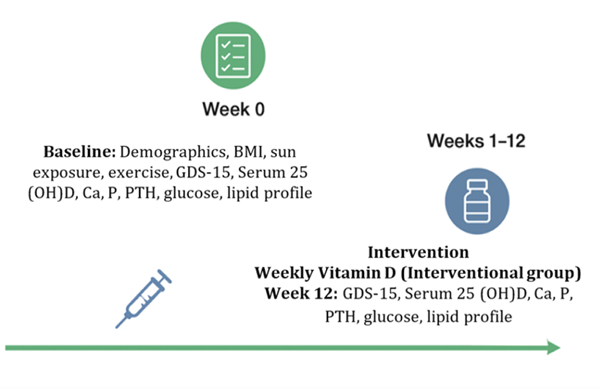
Baseline assessments included demographic information, BMI, daily sun exposure, exercise habits, and blood biochemical parameters. Follow-up assessments of GDS-15 scores and biochemical parameters were performed at 12 weeks post-intervention (Figure 1).
Statistical Analysis
Data were analyzed using Microsoft Excel and SPSS. Continuous variables are expressed as mean (SD), and categorical variables as percentages. Paired t-tests compared pre- and post-intervention values within groups, while the chi-square test analyzed categorical data. A p-value <0.05 was considered statistically significant.
Ethical Considerations
The study protocol was approved by the Institutional Ethics Committee (674/MC/EC/2025). Written informed consent was obtained from all participants. The study was conducted in accordance with the Declaration of Helsinki guidelines.
Results
At baseline, the interventional and placebo groups were largely comparable in sociodemographic characteristics. In both groups, females slightly outnumbered males, and most participants resided in urban areas. Family type distribution varied, with more joint families in the placebo group. Education and employment patterns showed a predominance of primary or secondary education, with higher unemployment in the placebo group. Socioeconomic status was largely upper-middle class across both groups.
The baseline comparison of different physiological variables between the interventional and placebo groups showed no statistically significant differences, except for Heart rate (p=0.001), which was significantly higher in the interventional group. Age, height, weight BMI, systolic and diastolic blood pressure, sun exposure, and daily exercise duration were comparable between the two groups, with p-values >0.05. Overall, both groups were largely similar in baseline physiological and lifestyle characteristics (Table 1).
After 12 weeks, significant improvements (p < 0.05) were observed in serum calcium, vitamin D, serum PTH, random blood sugar, and total cholesterol in the interventional group compared to placebo. Serum calcium and vitamin D levels increased markedly, while the serum PTH, random blood sugar, and total cholesterol were significantly decreased. Changes in phosphorus, HDL, LDL, and triglycerides were not statistically significant (Table 2).
At baseline, all participants in both groups (100%) had mild to moderate depression as per GDS-15 scores. After 12 weeks, 46.7% of the Vitamin D Interventional group improved to a normal range, while only 3.33% in the placebo group showed such improvement. The reduction in depression severity was statistically significant in the Vitamin D group (p < 0.001) but not in the placebo group (p = 1.000). This indicates that Vitamin D supplementation significantly improved depressive symptoms compared to placebo (Table 3).
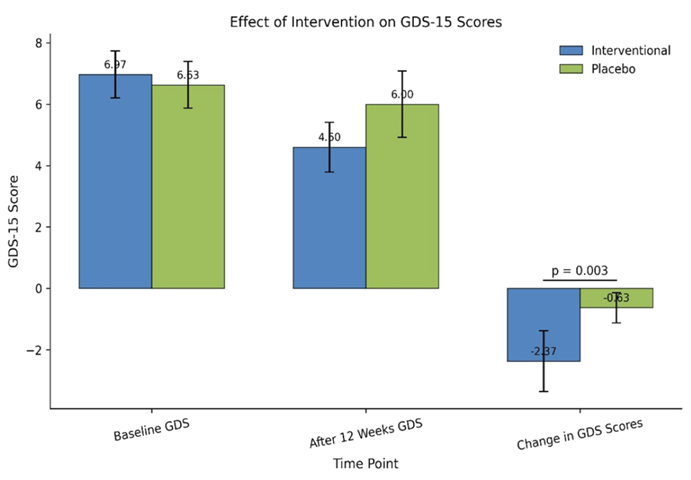
At baseline, the mean GDS scores were comparable between the interventional and placebo groups (p = 0.25). After 12 weeks, the interventional group showed a greater reduction in GDS scores (mean = 4.6, SD= 0.81) compared to the placebo group (mean = 6, SD= 1.08), though the difference was not statistically significant (p = 0.48). However, the mean change in GDS scores was significantly higher in the interventional group than in the placebo group with p = 0.003, indicating a significant improvement in depressive symptoms (Figure 2).
| Variable | Interventional (n = 30), mean (SD) | Placebo (n = 30), mean (SD) | p-value |
| Age (years) | 65.6 (5.3) | 65.7 (5.1) | 0.94 |
| Weight (kg) | 66.8 (9.4) | 64.4 (9.6) | 0.33 |
| Height (m) | 1.66 (0.09) | 1.64 (0.07) | 0.34 |
| BMI (kg/m²) | 24.4 (3.8) | 24.2 (0.1) | 0.77 |
| Systolic BP (mmHg) | 134.6 (12.9) | 129.3 (15.5) | 0.16 |
| Diastolic BP (mmHg) | 81.2 (9.3) | 81.9 (7.9) | 0.75 |
| Heart rate (/min) | 82.5 (11.3) | 74.0 (6.6) | 0.001 |
| Sun exposure (min/day) | 19.2 (5.3) | 18.4 (3.2) | 0.48 |
| Daily exercise (min/day) | 22.7 (8.7) | 21.3 (4.0) | 0.43 |
Note: Values are presented as mean (standard deviation). An independent samples t-test was used. Bold indicates statistical significance at p < 0.05.
| Parameter | Interventional (n = 30), mean (SD) | Placebo (n = 30), mean (SD) | p-value |
| Serum Calcium (mg/dl) | 0.35 (0.51) | −0.26 (0.58) | < 0.001 |
| Phosphorus (mg/dl) | 0.67 (0.28) | 0.27 (1.22) | 0.085 |
| Vitamin D (ng/ml) | 18.82 (4.77) | 1.07 (2.98) | < 0.001 |
| Serum PTH (pg/ml) | −8.78 (5.09) | 0.66 (5.21) | < 0.001 |
| RBS (mg/dl) | −10.5 (36.5) | 13.6 (33.6) | 0.010 |
| HDL (mg/dl) | 1.14 (7.5) | −2.69 (9.9) | 0.097 |
| Total Cholesterol (mg/dl) | −25.1 (42.4) | 9.33 (33.2) | < 0.001 |
| LDL (mg/dl) (mg/dl) | −1.88 (29.7) | −3.74 (26.0) | 0.797 |
| Triglycerides (mg/dl) | −16.5 (29.6) | −11.4 (38.4) | 0.567 |
Note: Values are mean (standard deviation). Independent samples t-test used. Bold indicates statistical significance at p < 0.05. PTH, parathyroid hormone; RBS, random blood sugar; HDL, high-density lipoprotein; LDL, low-density lipoprotein.
| Group | Category | Before intervention, n (%) | After intervention, n (%) | p-value (χ² test) |
| Interventional (Vitamin D)(n = 30) | Normal | 0 (0) | 14 (46.7) | <0.001 |
| Mild–moderate depression | 30 (100) | 16 (53.3) | ||
| Severe depression | 0 (0) | 0 (0) | ||
| Placebo (n = 30) | Normal | 0 (0) | 1 (3.3) | 1.000 |
| Mild–moderate depression | 30 (100) | 29 (96.7) | ||
| Severe depression | 0 (0) | 0 (0) |
Note: Values are presented as number (percentage). Geriatric Depression Scale-15 (GDS-15) score ranges: 0–4 = Normal; 5–10 = Mild–moderate depression; >10 = Severe depression. Bold indicates statistical significance at p < 0.05.
Discussion
This randomized controlled study found that vitamin D supplementation significantly alleviated depressive symptoms in older adults with vitamin D insufficiency, as evidenced by a marked reduction in GDS-15 scores compared with placebo. The biochemical outcomes corroborated these clinical findings, showing a substantial increase in serum calcium, 25(OH)D levels, a reduction in parathyroid hormone (PTH) concentrations, and favourable alterations in random blood sugar and lipid profile. In contrast, serum phosphorus levels remained unchanged. Collectively, these results suggest that correction of insufficiency of vitamin D may serve as a simple, safe, and modifiable strategy to improve both mental well-being and metabolic health in the elderly population.
The present findings contribute to the accumulating evidence linking vitamin D supplementation for better mood regulation and overall metabolic stability in late life. Multiple randomized trials and observational studies have reported similar benefits of supplementation, particularly in individuals with low baseline vitamin D levels. For instance, Alavi et al.(2019) [12],documented a significant improvement in depressive symptoms following weekly high-dose vitamin D in older adults, while Albuloshi et al.(2022) [13],and [14],[14]observed comparable improvements among broader adult cohorts, including those with major depressive disorder. Similarly, epidemiological investigations by Milaneschi et al.(2010) [15], and de Oliveira et al.(2017) [16], identified an inverse association between vitamin D deficiency and depressive symptomatology, particularly among postmenopausal women. While Hoogendijk et al.(2008) [17], and Jorde et al. (2008)[18], linked low vitamin D and elevated PTH levels with greater depressive burden. Consistent with these findings, our study demonstrated a significant reduction in GDS-15 scores following vitamin D supplementation, highlighting the therapeutic promise of vitamin D as an adjunctive strategy in the management of late-life depression.
Despite this growing body of evidence, literature on the topic remains also inconsistent. Several trials and meta-analyses have reported null or inconclusive results, reflecting differences in study design and participant characteristics. For example, Harris and Dawson-Hughes (1993) [19],and de Koning et al.(2019) [20], found no improvement in mood following supplementation, while Shaffer et al.(2014)[21], observed benefits limited to participants with clinically significant depressive symptoms. Similarly, Sanders et al. (2011) [22], detected no antidepressant effect using an annual high-dose regimen, and Tao et al. (2024) [23],reported increased risk of falls and fractures with intermittent bolus therapy. Recent meta-analyses by Park et al.(2023) [8], and Fu et al. (2024)[24],also concluded that vitamin D supplementation does not consistently improve depressive outcomes across diverse populations. These inconsistencies likely reflect variability in baseline vitamin D status, depression severity, dosing frequency, treatment duration, and outcome measures. Importantly, our study employed a physiological, sustained dosing regimen, which may explain the observed improvements, emphasizing the relevance of tailoring supplementation protocols to patient characteristics.
Vitamin D and Depression: Biological Plausibility: Vitamin D influences depression through multiple biological pathways. Its active form crosses the blood–brain barrier, binding to receptors in mood-related regions (hippocampus, prefrontal cortex) [25], It regulates neurotransmitters by enhancing central serotonin production via TPH2 and modulating the levels of dopamine and norepinephrine [26], Vitamin D promotes neurotrophins (BDNF, NGF), supporting neuroplasticity and resilience [27]. It exerts anti-inflammatory effects by reducing IL-6, TNF-α and increasing IL-10, thereby mitigating neuroinflammation. Additionally, it stabilises the HPA axis, reducing cortisol hypersecretion, and protects neurons by regulating calcium homeostasis and enhancing antioxidant defences [28], Collectively, these mechanisms provide strong biological plausibility for its antidepressant effects.
Strengths and limitations: This randomised controlled study has several strengths, including its robust design, use of validated tools such as the GDS-15, and single-blind methodology, minimizing bias. Targeting vitamin D–insufficient individuals enhanced the likelihood of detecting clinical benefits, while subgroup analyses by depression severity provided additional insights. The 12-week intervention demonstrated consistent improvements in mood and biochemical status. However, limitations include a modest sample size, a single-centre setting, and short follow-up, which may restrict generalizability and long-term implications. Lifestyle factors were not systematically monitored during this study period. Also, the inflammatory and neurotrophic markers were not assessed. Future multicenter, longer-duration studies with biomarker evaluation are warranted.
Clinical Implications and Future Directions: This study underscores the need to routinely screen for vitamin D deficiency in patients with depression, especially in high-risk populations. Given its safety, affordability, and accessibility, vitamin D supplementation offers a valuable adjunct to conventional therapies within a holistic management framework. Future large, multicenter trials with extended follow-up and biomarker assessment are warranted to confirm efficacy and explore synergistic strategies integrating nutrition, exercise, and psychotherapy.
Conclusion
Improving vitamin D status represents a safe, low-cost, and scalable intervention with the potential to provide dual benefits by enhancing metabolic health while alleviating depressive symptoms in late life. The observed biochemical and clinical improvements underscore vitamin D supplementation as a modifiable factor in neuropsychiatric care and support its relevance within integrated clinical and public health strategies aimed at addressing the combined burden of depression and metabolic dysregulation in ageing populations.
Declarations
Acknowledgements
Author sincerely thanks all the participants for their cooperation and valuable contribution to this study. Special thanks are extended to the Psychiatry Department for their assistance in patient identification and to the Department of Biochemistry for their support in conducting the blood investigations.
Conflict of interest
None
Funding/ financial support
No funding was received for the study.
Contributors
The work was carried out under the supervision and guidance of Anuradha Yadav. The data acquisition and literature search by Sandeep Saxena. All authors contributed to the research concept, design, data analysis and to the writing of the manuscript.
Ethical Clearance
Approval was taken by the Institutional Ethics Committee (674/MC/EC/2025).